

South Korea is a country in East Asia on the southern half of the Korean Peninsula. Seoul is its capital, and it is known for K-pop, Korean food, busy cities and a modern, safe travel experience.
South Korea is a small peninsula punching way above its weight. A country roughly the size of Indiana has somehow given the world Samsung phones, Parasite, BTS, kimchi jjigae, and a webtoon industry that turned smartphone screens into comic book pages. If you’re trying to understand what’s actually going on in South Korea right now, whether you’re planning a trip, curious about the culture, or just tired of not knowing why everyone keeps talking about K-dramas, this is the rundown.
Where is South Korea?
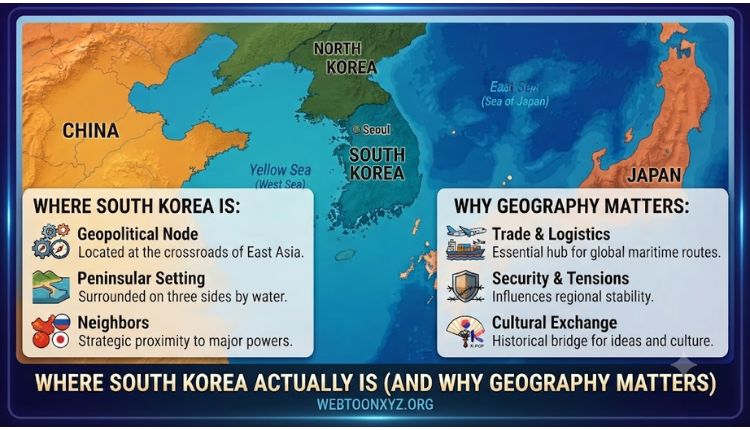
The country is mountainous, coastal, and compact enough that you can take a high-speed KTX train from Seoul to Busan, roughly 325 kilometers, in under three hours. That density is part of why South Korean cities feel so alive. Everything is close together, and almost everyone is connected to it through a phone.
Which cities should you visit in South Korea?
Seoul is the capital and the center of gravity for basically everything South Korean: government, entertainment, tech, fashion. Neighborhoods like Gangnam (yes, that Gangnam), Hongdae, and Itaewon each have a completely different personality, Gangnam is glossy and corporate, Hongdae is loud and full of university students, Itaewon is where the international crowd tends to land. Seoul also has palaces like Gyeongbokgung sitting a few blocks from glass skyscrapers, which tells you a lot about how the country handles the old and the new.
Busan, on the southeastern coast, is the country’s second city and its main port. It’s beaches, seafood markets, and the Busan International Film Festival, which has become one of the more important film festivals in Asia. If Seoul is the brain of South Korea, Busan is closer to its lungs.
Smaller cities like Jeonju (famous for bibimbap and traditional hanok villages) and Gyeongju (an open-air museum of old Silla dynasty tombs and temples) round things out for anyone who wants South Korea without the crowds.
What food is South Korea known for?
You cannot talk about South Korea without talking about the food, because the food is basically load-bearing for the culture. Kimchi, fermented, spiced cabbage, shows up at nearly every meal, and there are entire museums dedicated to it. Korean barbecue (grilling meat right at your table) has become a global export in its own right, but locally it’s just Tuesday dinner.
Street food is its own category worth knowing: tteokbokki (spicy rice cakes), hotteok (sweet stuffed pancakes), and gimbap (the less-famous cousin of sushi) are sold from carts in nearly every neighborhood. Then there’s the drinking culture around soju, which is cheap, strong, and treated almost like a social lubricant with its own etiquette rules, pour for others, not yourself, and never refuse a first drink from someone older.
Why did Korean pop culture take over the world?
This is the part that actually explains most of the current global obsession. South Korea’s government invested heavily in cultural exports starting in the late 1990s, after the Asian financial crisis forced the country to look for new industries. That bet paid off in ways nobody fully predicted.
K-pop groups like BTS and Blackpink turned into global stadium-fillers. K-dramas moved from regional hits to Netflix’s most-watched category almost overnight, with shows like Squid Game becoming a genuine cultural moment rather than a niche interest. And running quietly underneath all of it is the webtoon industry, vertical-scroll digital comics that originated in South Korea and have since reshaped how comics get made and read worldwide.
Webtoons matter here specifically because so many K-dramas and even K-pop concepts started life as webtoons first. If you’re getting into Korean pop culture and want to understand where a lot of it actually begins, it’s worth looking at Korean webtoons directly rather than waiting for the drama adaptation. The format itself, full-color panels built for scrolling on a phone, not turning a page, is a South Korean invention that changed the comics industry the same way K-pop changed the music industry, know more clicke here.
For readers coming from Western comics, webtoons like these can feel like a different medium entirely: faster pacing, cliffhangers built for weekly releases, and art styles that lean heavily on mood and color rather than dense paneling. And since manhwa (the Korean term for comics generally) covers a huge range of genres, from romance to horror to historical drama, there’s a real case that manhwa deserves as much attention internationally as anime already gets.
If you’re just starting out and want a wider net to browse before committing to a series, a general webtoon hub or a broader collection is a reasonable place to poke around and see what genres actually click for you.
When is the best time to visit South Korea?
Spring (April to early June) and autumn (September to November) are the two windows most travel guides, and most Koreans, will point you toward. Spring gets you cherry blossoms, especially around Jinhae and along the Han River in Seoul. Autumn gets you the foliage in places like Naejangsan National Park, plus milder temperatures than the brutal, humid summers.
Summer (July to August) brings monsoon rain and heat that makes walking around Seoul genuinely uncomfortable. Winter is cold and dry, with proper snow in mountain regions, which is great if you’re heading to a ski resort like the ones used for the 2018 Winter Olympics in Pyeongchang, less great if you just wanted to wander around outdoors all day.
Is South Korea safe for travelers?
South Korea consistently ranks as one of the safer countries for travelers, with low violent crime rates and a strong public transit system. The bigger practical concerns are usually mundane: language barriers outside major tourist areas (though signage in Seoul and Busan is heavily bilingual), the occasional culture shock around drinking etiquette, and the fact that cash still matters more than you’d expect in a country this technologically advanced, some smaller restaurants and markets don’t take foreign cards.
Getting a T-money transit card on arrival is close to essential; it works on subways, buses, and even some taxis and convenience stores across the whole country, not just one city.
The Bottom Line
South Korea works because it doesn’t separate its old identity from its new one, palaces sit next to skyscrapers, centuries-old fermentation techniques show up in food trends, and a comics format built for smartphones has become one of the country’s biggest cultural exports. Whether you’re drawn in by the travel, the food, or you started down this rabbit hole because of a webtoon you couldn’t stop reading, South Korea rewards actually paying attention to the details rather than skimming the surface.
Frequently Asked Questions
What is South Korea known for?
Technology (Samsung, LG), K-pop, K-dramas, webtoons, kimchi and Korean barbecue, and a rapid post-war economic transformation often called the “Miracle on the Han River.”
How many days do you need in South Korea?
Most first-time visitors budget 7 to 10 days, splitting time between Seoul, Busan, and at least one smaller city like Gyeongju or Jeonju.
Is English widely spoken in South Korea?
In Seoul and Busan’s tourist areas, yes, reasonably well, especially among younger people. Outside major cities, it drops off quickly, so a translation app is genuinely useful.
What’s the difference between manhwa and webtoons?
Manhwa is the general Korean term for comics. Webtoons specifically refer to the vertical-scroll, digital-first format that became South Korea’s dominant comics style and export.
For background on the format, see the Wikipedia entry on webtoons.
Frequently Asked Questions
What is the capital of South Korea?
Seoul is the capital and largest city of South Korea.
When is the best time to visit South Korea?
Spring and autumn are the most popular seasons because the weather is mild and the scenery is at its best.
Is South Korea safe for tourists?
South Korea is generally considered safe for travelers, but you should still follow normal travel precautions and local advice.

