Manhwa raw means Korean comics in the original language, before fan or official translation. Reading raws from unofficial sites is risky, so official translated platforms are the safer choice.
If you’ve typed “manhwa raw” into Google, you’re probably chasing one of two things: the untranslated Korean version of a series you already love, or a faster way to read chapters before the official translation drops. Both reasons make sense. Scanlation groups and translation teams can take days or weeks to catch up with Korea’s release schedule, and that gap is exactly where the term “raw” comes from.
This guide breaks down what manhwa raw actually refers to, why the search term is so popular, and what your safer options look like if you want to keep reading without running into broken sites, malware, or dead links.
What does manhwa raw mean?
“Raw” is scanlation slang for the original, untranslated version of a comic straight from its home country. For manhwa, that means the Korean-language chapter exactly as it was published on platforms like Naver Webtoon or KakaoPage, before any fan group or licensed publisher touches it.
People search for raws for a few reasons:
- They read Korean and don’t need a translation.
- They want to see the artwork and panel layout before the official release.
- Translation teams have dropped a series, and raws are the only way to keep up.
- They’re comparing translation choices against the original text.
Raws are not the same as scans, and scans are not the same as an official release. Mixing those terms up is where a lot of confusion (and a lot of shady websites) comes from.
What is the difference between raw, scanlation and official translation?
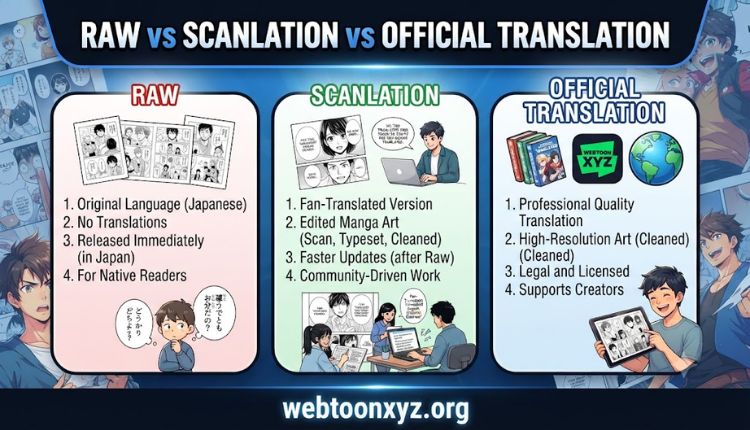
Here’s a quick breakdown of how these three actually differ, since the terms get thrown around interchangeably online.
| Type | Language | Source | Legal Status | Typical Quality |
| Raw | Original (Korean) | Leaked or purchased from the publisher’s app/site | Often unlicensed if shared without permission | Native art quality, no text edits |
| Scanlation | Fan-translated | Volunteer groups working from raws | Usually unauthorized, exists in a legal gray area | Varies widely by group |
| Official Translation | Localized by the publisher | Licensed platforms | Fully legal | Consistent, professionally edited |
The takeaway: raws sit at the very start of that chain. Everything else, translated fan work or an official release, is built on top of them.
Why is manhwa raw such a popular search term?
Korean webtoons release fast. A hit series can drop a new chapter every week, sometimes with barely any lag between the Korean release and international attention. Translation teams need time to localize text, clean up art, and format pages for other platforms. That delay is frustrating for readers who are already caught up, so they search for raws to close the gap.
There’s also a discovery angle. Some readers find a manhwa through a clip or fan art online, search the title, and land on “raw” results before they even realize a translated version exists somewhere like the pages covering manga as a whole or dedicated explainer posts on how sites in this space actually work, such as the breakdown of what Webtoon XYZ offers and how to use it safely.
Is reading manhwa raw safe and legal?
This is the part most search results skip over. A few honest points worth knowing before you go hunting for raws:
Copyright still applies: Raws are pulled from paid or ad-supported platforms in Korea. Redistributing them without permission is a copyright violation in most countries, even if no money changes hands.
Sketchy sites are common in this niche: Because raw content isn’t hosted by the original publisher, a lot of the sites offering it rely on aggressive ads, pop-ups, and sometimes outright malware to make money. If a site throws five redirect windows at you before showing a single page, that’s a red flag.
Official apps are cheap and often free: Naver Webtoon and similar platforms let you read a huge back catalog for free, with new chapters unlocked through a simple wait-or-pay system. For most readers, that’s a far less risky trade-off than digging through raw aggregator sites.
If you’re set on reading raws for language practice or research, sticking to the publisher’s own app is the safest route. It cuts out the malware risk entirely and actually supports the creators.
Where do manhwa raws come from?
Raw scans typically originate from a small number of sources:
- Official Korean platforms, Naver Webtoon, KakaoPage, and Lezhin are the big three, and most raws are screenshotted or ripped from these apps.
- Aggregator sites, Third-party sites compile raws from multiple platforms into one place, usually without permission.
- Community forums, Some Discord servers and forums share raws privately among members who then pass them to scanlation teams.
This is also where naming confusion creeps in. Readers searching for raws often stumble across near-identical site names, things like Wentoons XYZ, Webtoonz Cyz, or WBTOON XYZ. These lookalike names spread through typo traffic and copycat domains, and it’s worth reading up on what each one actually is before clicking through, since not all of them host the same content or operate the same way, know more click here.
What are better ways to read manhwa than chasing raws?
If the goal is simply reading a series without the multi-week translation wait, there are a few options that don’t involve gray-market raw sites:
- Use the publisher’s fast-pass system: Most Korean platforms let you unlock upcoming chapters early for a small fee, which is often the actual fastest legal route.
- Follow licensed international apps: Many manhwa now get same-day or same-week official English releases through licensed apps.
- Check community guides before picking a site: Comparison posts like Webtoons Xuz, Webtoons XY, and Webcomics XYZ walk through what different reading platforms actually offer, which helps you avoid wasting time on a site that’s mostly ads.
- Look for a list of alternatives: If your usual site goes down, a roundup like Comics Like Webtoon gives you a shortlist instead of forcing another blind search.
Which manhwa raw search terms do people confuse?
Because “manhwa raw” sits in such a crowded, typo-heavy corner of search, a lot of adjacent terms get lumped in with it. A few worth knowing:
- Korean webtoon free, readers looking for free access rather than raw text specifically. There’s a full explainer on Korean Webtoon Free covering what that actually looks like.
- XYZ Webtoons, a broader catch-all search that overlaps heavily with raw and scan searches, covered in XYZ Webtoons.
- Webtoon ZYX, another commonly confused variant, broken down in Exploring The Fascinating World of Webtoon ZYX.
If you searched “manhwa raw” and aren’t finding what you expected, one of these related terms might actually match what you’re after.
How can you tell if a manhwa site is safe to use?
Not every site hosting raws or scans is dangerous, but a few warning signs are worth checking for before you commit:
- Multiple pop-ups or forced redirects on a single click
- No HTTPS in the address bar
- Requests to install an “extension” or “player” to view a chapter
- Ads disguised as download buttons
- No visible contact page or site information
A cleaner, more transparent site will usually just show you the content without gatekeeping it behind extra downloads or five layers of ads.
FAQs About Manhwa Raw
What does “raw” mean in manhwa?
Raw refers to the original, untranslated version of a manhwa chapter, usually in Korean, before any scanlation or official localization happens.
Is it illegal to read manhwa raws?
Reading them isn’t usually prosecuted, but distributing raws without the publisher’s permission is a copyright violation in most countries. Reading through the official Korean app is the only fully clean option.
Why are raws released before translated versions?
Translation, editing, and formatting take time. Raws come straight from the source with none of that extra work applied, so they’re always first.
Can I read manhwa raw for free legally?
Yes, through the publisher’s own platform, such as Naver Webtoon or KakaoPage, where a portion of the catalog is free, and new chapters unlock through a wait system.
Are raw scan sites safe?
Some are fine, but many rely on intrusive ads and redirects to generate revenue. Watch for excessive pop-ups, forced downloads, or missing HTTPS before trusting a new site.
What’s the difference between manhwa raw and manhwa scan?
A raw is untranslated. A scan (or scanlation) is a raw that’s been translated and edited by a fan group, usually into English or another language. For background on the format, see the Wikipedia entry on webtoons .
Conclusion
“Manhwa raw” is really just shorthand for getting as close to the source as possible, reading a chapter the moment it lands in Korea, before anyone else has touched it. That’s a reasonable thing to want, but it comes with real trade-offs: copyright gray areas, sketchy ad-heavy sites, and content with zero editing or translation if you don’t read Korean.
If you’re after speed, official fast-pass systems get you there legally. If you’re after variety, a translated library will almost always serve you better than a pile of raw files. And if you’re not sure where to start, the guides on Webtooms Xyz and Webtoon YXZ are a decent jumping-off point for exploring the wider manhwa and webtoon reading landscape without falling into the same five sketchy sites everyone else does.