Player manhwa are Korean comics where the main character is a player in a game or leveling system. Solo Leveling, The Gamer and Return to Player are well-known examples of the genre.
If you’ve searched “player manhwa” and landed on ten different answers, you’re not alone. The term gets used two ways online: as the actual title of a Korean webtoon called Player, and as shorthand for the whole genre where the main character becomes a “player” inside some kind of game-like system. Both are worth knowing about, so this guide covers each one, plus where the term overlaps with popular series like Solo Leveling and The Player Who Can’t Level Up.
What does “player” mean in a manhwa?
In most system manhwa, a “Player Manhwa” is a person who gets pulled into a hidden game layered on top of reality. They see stat screens, get quest notifications, and level up by fighting monsters or completing tasks. Sometimes only one character is a player (like Sung Jin-Woo in Solo Leveling). Other times an entire tower, city, or country is forced to play, and the story follows who survives the rules.
That’s the genre meaning. There’s also a specific webtoon literally titled Player, originally published on Naver Webtoon and written by Jong-Seok Park with art by Hyeon-Jun Oh. A separate, earlier Player series by Dalgoon and JINJOO centers on a mysterious game that promises wealth and power to anyone who wins it, with a plot that leans harder into strategy and leadership than raw power fantasy. If you search “player manhwa” expecting one specific story, it helps to check which of these two you actually mean before you start reading, since they don’t share a timeline or characters.
Why did the player trope take over webtoons?
Leveling-system stories didn’t come out of nowhere. Korean webtoons have leaned into gaming mechanics for over a decade, but a few things pushed “player” style stories into the mainstream:
- Instant progress you can see: A number going up (level, rank, stat point) gives readers a concrete payoff every chapter, which works well in a format built around quick, serialized reading.
- Low barrier to entry: You don’t need to know a character’s full backstory to understand “he was E-rank, now he’s S-rank.” The system explains itself.
- Room for underdog stories.: Almost every player starts weak. Whether it’s Jin-Woo in Solo Leveling or Gigyu in The Player Who Can’t Level Up, the appeal is watching someone written off as useless flip that script.
- Crossover appeal with gamers: Readers who play RPGs already understand stat menus and skill trees, so the learning curve for the story format is basically zero.
None of that explains why one “player” story clicks and another doesn’t. Art quality, pacing, and whether the side characters actually matter still decide that. Click here.
What are the top player and system manhwa to read?
Here’s how the best-known titles in this space compare, so you can pick one based on what you actually want out of it.
| Title | Core Hook | Tone | Tone |
| Solo Leveling | Weakest hunter gains a private leveling system | Dark, action-heavy | Readers who want nonstop power growth |
| Player (Naver Webtoon, Park & Oh) | A defined “player” role inside a larger hidden game | Mystery, tension | Readers who like slow-burn plot reveals |
| Player (Dalgoon & JINJOO) | A game offering wealth and power to its winners | Strategy, drama | Readers who want tactics over brawling |
| The Player Who Can’t Level Up | A player stuck at level one for five years | Underdog, emotional | Readers who want a longer grind before payoff |
| Return to Player | A washed-up player regresses in time with full knowledge | Revenge, fast growth | Readers who like time-loop or regression plots |
| Second Life Ranker | A soldier gains supernatural power after his brother’s death in a tower game | Gritty, isekai | Readers who want a revenge arc with combat depth |
| The Gamer | A student suddenly sees quest screens over ordinary life | Slice-of-life, comedic | Readers who want the system dropped into a normal world |
None of these need to be read in any order. They don’t share continuity, so pick whichever hook sounds most interesting and start there.
How is player manhwa different from regular isekai?
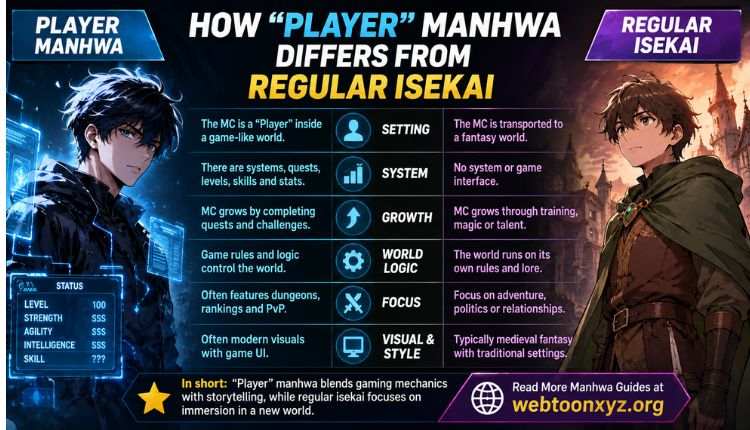
Isekai usually means a character gets sent to another world entirely, often after dying. Player manhwa keeps the character in their own world, or a world close enough to it, and layers a game system on top instead. That distinction matters for pacing: isekai spends time on world-building a new setting, while player stories spend that time on stat screens, skill trees, and the mechanics of the game itself. Some series blend both, like Second Life Ranker, where the “other world” and the “game system” are the same thing.
If you’re newer to the genre, our broader manga guide is a good place to see how Japanese comics differ from manhwa in art style and reading direction, since a lot of “player” confusion online comes from people mixing up manga and manhwa search terms.
Where can you read player manhwa?
Most of these titles started as Naver Webtoon originals in Korean, with official English translations available through licensed platforms like Player Manhwa, Tapas, or Tappytoon. If you’re trying to figure out how sites that aggregate webtoons actually work, and what to watch out for, our Webtoon XYZ breakdown covers that in more detail, including the safety basics like avoiding pop-ups and sketchy redirect ads.
For readers who are still getting used to reading manhwa online in general, our guide to reading manhwa walks through how manhwa differs from manga and manhua, and what genres tend to show up most in the “player” and system-fantasy space.
What tips help new readers start player manhwa?
A few things make the first few chapters of any player manhwa easier to follow:
- Expect an info-dump early on: Most series explain the system rules (stats, quests, leveling) within the first three to five chapters. Skimming past this part makes later chapters confusing.
- Don’t expect fast romance: Power growth is the priority in almost every title on this list. Romantic subplots, when they exist, usually show up much later.
- Track the numbers loosely, not exactly: You don’t need to memorize every stat point. Pay attention to relative growth (weak to strong) rather than the specific numbers.
- Check if it’s a manhwa or a novel adaptation first: Several “player” style stories started as web novels before getting a manhwa version, and the two can move at different speeds. Our manhwa chapters explainer covers how chapter releases typically work if you’re used to reading full novels instead.
FAQs About Player Manhwa
Is “Player” manhwa the same thing as Solo Leveling?
No. Solo Leveling is its own series with its own system and cast. “Player” style just describes the shared trope, similar to how “isekai” describes a category rather than one show.
Which “Player” manhwa should I start with if I only read one?
If you want fast-paced action, start with the Naver Webtoon Player by Jong-Seok Park and Hyeon-Jun Oh. If you’d rather read something built around strategy and negotiation, the Dalgoon and JINJOO Player leans that direction instead.
Are player manhwa always Korean?
The trope originated in Korean webtoons and web Player Manhwa, and most well-known examples still are. Similar leveling-system stories exist in Japanese light novels too, though they’re usually filed under a different label there.
Do I need to read the web novel before the manhwa?
No. Most manhwa adaptations are written to stand on their own. Reading the novel first can spoil pacing, since manhwa versions sometimes compress or reorder scenes for visual storytelling.
Is this genre still getting new titles?
Yes. System and leveling stories are still one of the most common new releases on Korean webtoon platforms, partly because the format translates well into a visual medium with clear stat screens and skill effects. For background on the format, see the Wikipedia entry on webtoons .
Conclusion
“Player manhwa” isn’t a single story; it’s a whole shelf of them, plus one specific title that keeps getting mixed up with the broader trope. Whether you’re here for the literal webtoon Player or you just want more stories where the underdog levels up and gets their revenge, the titles above are a solid starting list. Start with whichever hook sounds most fun, and branch out from there once you know what you actually like about the genre.